
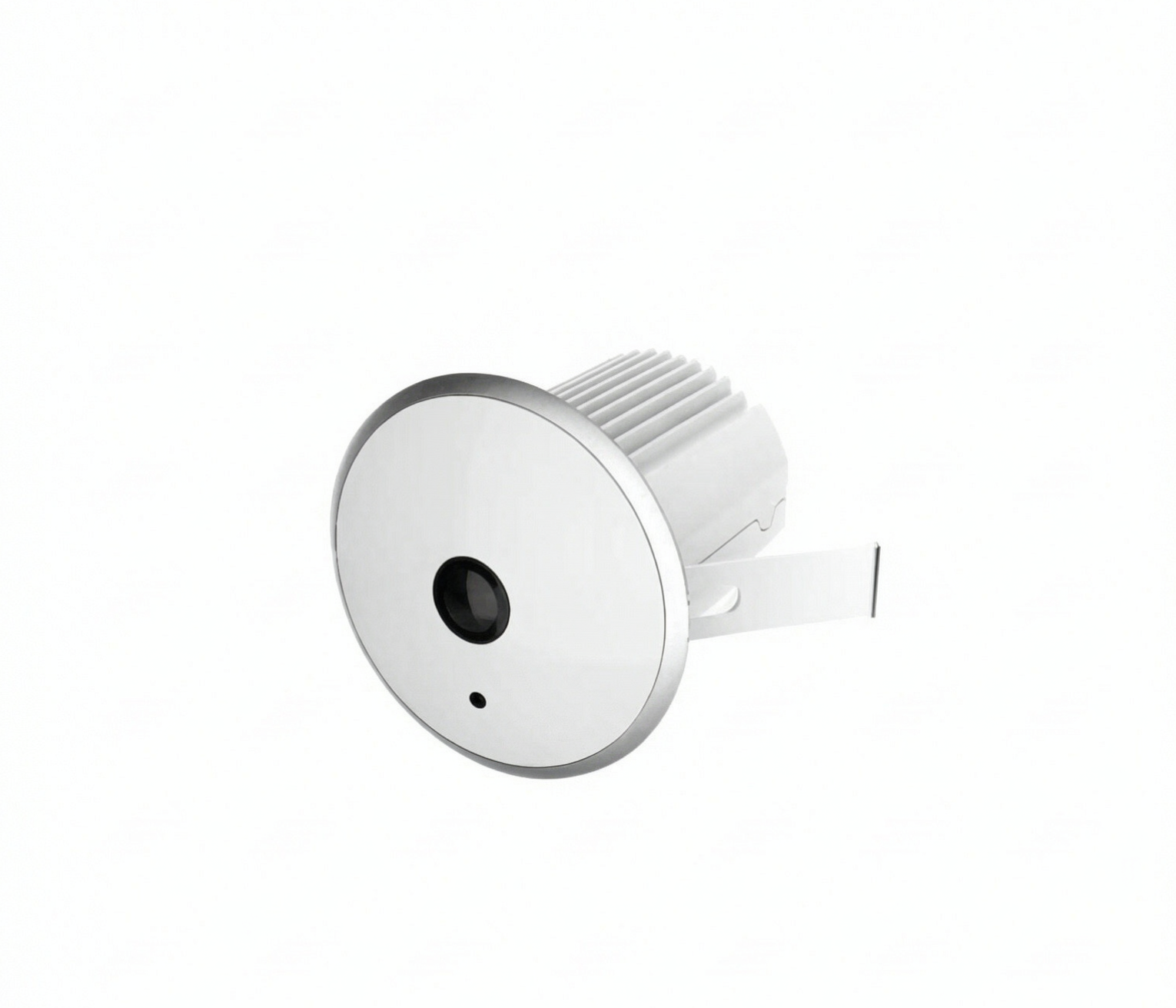
What is an embedded 2D AI camera?How does it complete people counting without damaging the interior decoration?
From "drilling holes and laying cables" to "embedded ceiling mounting": how installation methods affect store decisions
Traditional people counting solutions typically require drilling holes in the ceiling, laying cables, and mounting external equipment boxes, which for an already decorated store means damaging the ceiling, rewiring, and even causing a construction shutdown period. The HooViz 2D AI economy people counting camera adoptsembedded ceiling mounting, where the camera body is embedded into the ceiling opening, with only the lens surface exposed, minimizing impact on the decoration.
Installation requires cutting one mounting hole, but that's all. The device supports both DC12V and PoE power supply — if the store network already supports PoE switches, a single network cable can simultaneously handle power supply and data transmission, eliminating the need for additional power cabling. For stores that are already renovated, the construction impact is basically limited to one small opening and one network cable;For stores that are not yet renovated, the cabling can be reserved in advance during ceiling installation, making the process almost imperceptible.
How on-device AI achieves localized precise recognition instead of relying on the cloud
This camera is equipped with 2.0 TOPSof on-device AI inferencecomputing power, and pedestrian detection, tracking, and trajectory generation are all completed locally on the device, without the need to upload video streams to the cloud for processing. This means two things: first, even if the store network is interrupted, foot traffic statistics continue to work normally, and data will not be lost due to network disconnection;Second, the raw video data does not need to leave the store, which is a substantial security boundary for operators who value customer privacy or data compliance.
It should be noted that the device supports ONVIF/RTSP protocols. If you wish to integrate with a third-party footfall platform or view real-time footage in the future, data can be output via the network—but this is your choice, not a prerequisite for operation. of on-device AI inferenceCompared to cloud-based solutions, it does not depend on network bandwidth and stability, offers higher real-time recognition, and incurs no ongoing upload traffic costs. The camera's 2.0 TOPS computing power is sufficient to support real-time pedestrian detection and tracking at 1080P resolution. Combined with a starlight-grade CMOS sensor, it maintains recognition accuracy even in the low-light conditions commonly found in stores.
Core capabilities of entry/exit footfall statistics: how high-precision pedestrian detection and multi-focal length adaptation address different store scenarios
From 1.1mm to 2.8mm: how to choose the lens focal length for different door widths
The door width directly determines whether the lens can fully cover the entrance area. The HooViz 2D AI Economy Footfall Camera offers three focal length options—1.1mm, 2.1mm, and 2.8mm—to suit store entrances of varying widths.
| Lens Focal Length | Suitable Scenarios | Selection Recommendations |
| 1.1mm | Large entrances, mall entrances, wide passages | Prioritize when door width exceeds 3 meters; wide-angle view covers a larger entrance area. |
| 2.1mm | Standard single doors, small and medium-sized stores | Balanced choice for regular store entrances |
| 2.8mm | Narrow doors, standalone counters, aisles | Used when the door width is narrow; pedestrians occupy a larger proportion of the frame |
Selection tips: For door widths over 3 meters, prioritize a 1.1mm focal length. Note that the shorter the focal length, the smaller the pedestrian size at the edges of the frame, which imposes higher demands on the detection algorithm—this is where on-device AI inference plays a role.
How high-precision pedestrian detection and real-time tracking enhance counting reliability
The core of counting reliability lies indetection + trackingtwo steps:
- Pedestrian detection: The algorithm identifies the "person" target in each frame, rather than relying on infrared beams or floor mat triggers.In scenarios such as two people walking side by side, pushing a shopping cart, or looking down at their phones, they can still be recognized as independent individuals.
- Real-time trajectory tracking: By continuously tracking, it determines the movement direction of the same person, distinguishing "in" from "out".Customers hesitating, turning back, or lingering at the entrance will not be double-counted or missed.
In addition, the camera is equipped with a 1/2.8" starlight-grade CMOS sensor, which retains basic imaging capability in low-light conditions, helping to maintain detection continuity. It should be noted that detection performance is affected by installation angle and lighting conditions. If the store entrance has strong backlighting or the installation height exceeds 3.5 meters, it is recommended to provide on-site photos to the HooViz team to confirm suitability.
Which scenarios are suitable for the embedded 2D AI people counting camera?Adaptation boundaries from store entrances to shopping mall atriums
Store entrances and supermarkets: typical scenarios for entry and exit traffic counting
If your core need isto accurately count how many people enter and exit each day and identify peak periodsIn that case, an embedded 2D AI people counting camera is a directly applicable solution near store entrances and supermarket checkout lines.
These scenarios share several common characteristics: relatively fixed door width, controllable installation height (typically 2.5-4 meters), and clear pedestrian flow directions (in/out/pass-by). The HooViz camera offers multiple lens options: 1.1mm, 2.1mm, and 2.8mm, corresponding to different door widths—use a telephoto lens for narrow doors to reduce false detections, and a wide-angle lens for wide doors to cover the full passage. With 2.0 TOPS of on-device computing power for pedestrian detection and tracking, there is no need to send video to the cloud for analysis, which meanseven if the network is unstable, counting will not be interrupted.。
Criteria to help you decide:
- You have clear requirements for calculating 'footfall rate' and 'conversion rate', and need footfall data as the denominator.
- The store entrance is already fully renovated, and you prefer not to drill holes or run cables for equipment installation—embedded ceiling mounting causes minimal disruption to the ceiling.
- It is necessary to integrate with existing POS or third-party foot traffic platforms, and ONVIF/RTSP protocols can complete the integration.
Shopping mall atriums and exhibition areas: extended applications of storefront traffic counting and regional heat analysis.
Shopping mall atriums have dense foot traffic and complex movement patterns, which is precisely where the 2D camera'sboundaries lie.。
Let's start with what can be done: the 'storefront traffic' statistics for stores around the atrium—that is, the number of people who pass by the store entrance but do not enter—this camera can accomplish. It uses pedestrian detection and real-time trajectory to distinguish between 'passing by' and 'entering', outputting the number of passersby, which is used to evaluate the storefront's location exposure value. Regional attention and dwell time heat maps can also answer questions like 'which corner of the exhibition area attracts people to stay the most'.
But be aware of the boundaries:Crowd density statistics in the central atrium and large open areas are not a strength of 2D monocular cameras.。 When dozens of people appear in the frame simultaneously and heavily occlude each other, the geometric features that 2D cameras rely on are disrupted, and counting errors increase significantly. If you need large-scale crowd analysis such as 'total atrium headcount' or 'area density heatmap', you need to confirm the specific installation height and coverage area before determining whether it matches—it is recommended to provide the HooViz team with your floor height, target coverage area dimensions, and expected peak crowd flow, and they will provide a matching solution for lens focal length and installation position.
Besides counting people, what else can be analyzed?
- Dwell time: How long a customer stands in front of a booth, distinguishing between 'passing by with a glance' and 'genuinely interested'.
- Attention ranking: The proportion of attention received by different locations within the same exhibition area, used to optimize displays or booth layouts.
- Movement trajectory: Determine whether the aisle design guides the expected flow by observing where customers come from and where they go.
These analyses require no additional hardware; the same device outputs them while counting.
Scenarios not suitable for
- Requiresfacial recognitionoridentity attributes(Age, gender) analysis — this is a clear boundary for 2D economy cameras.
- RequiresCross-floor, cross-zone people tracking— a single device only covers a fixed field of view.
- RequiresFull path reconstruction for each individual— 2D tracking may lose IDs after occlusion.
If your needs fall within the above scope, the current solution is not a match, and you need to confirm a higher-tier product line with the team.
Selection judgment: Who is the 2D AI economy people-counting camera suitable for?Where is the boundary between budget and needs?
When is a 2D AI solution the most cost-effective choice?
If your customer flow requirements are already clear—counting entries and exits, passing traffic, and dwell time in areas—and you have many stores with a limited budget, a 2D AI solution is the more cost-effective option. Compared to 3D solutions, it eliminates the additional hardware cost of depth sensors;Compared to cloud-based solutions, it does not require ongoing subscription fees. The device is installed embedded in the ceiling, minimizing impact on already renovated stores. The 2.0 TOPS edge AI inference completes statistics locally, without the need for additional server configuration.
Typical characteristics suitable for choosing a 2D AI solution:
- Clear requirements: only need statistical results such as entry/exit traffic, passing traffic, and area attention, without advanced features like facial recognition.
- Store entrances are within the standard width range and can be matched with 1.1/2.1/2.8mm multi-focal length lenses.
- The existing system supports ONVIF/RTSP standard protocols and can be directly integrated.
When should you upgrade to a more complete solution?
Consider a 3D or higher-level solution in the following situations:
- If requirements are still changing frequently, and statistical calibers and analysis dimensions are not yet finalized, hasty deployment may lead to rework.
- If deep customized integration with specific third-party platforms is needed, and devices only support ONVIF/RTSP standard protocols, compatibility with all private platforms is not guaranteed.
- If features beyond people counting scope, such as facial recognition or customer identity association, are required.
- During peak hours with extremely dense crowds and severe occlusion, the counting accuracy of 2D solutions will decrease.
Questions to confirm before implementation:
- What are the entrance width and installation height of the store?This determines the selection of the lens focal length.
- Does the existing customer flow platform or third-party system support ONVIF/RTSP access?What is the specific version number?
- Does the installation location have stable power supply or PoE switch?Are the network cabling conditions satisfied?
FAQ
Q: Which is more cost-effective, the 2D or 3D solution? If only entrance/exit traffic statistics and zone heat analysis are needed, the 2D solution has lower hardware costs and no cloud subscription fees, offering higher cost-effectiveness. The 3D solution provides better accuracy in dense occlusion scenarios, but the cost increases significantly, making it suitable for scenarios with strict accuracy requirements.
Q: Can it integrate with our existing traffic platform or third-party systems? The device supports ONVIF/RTSP standard protocols and can connect to platforms that support these protocols. However, different platforms may define the data structure of traffic events differently. Before deployment, you need to confirm whether your platform version is already adapted, or whether lightweight interface mapping is required.
Q: Can the device work offline? AI inference is performed on the device, so statistical functions are not affected in offline mode. However, remote data viewing or platform integration requires a network connection. During offline periods, data is stored locally. After reconnecting, you need to confirm whether the platform supports data backfill.
Learn More
If your store or venue is considering a foot traffic counting solution, feel free to submit your installation environment (door width, ceiling height, peak foot traffic) and a description of your needs. The HooViz team will match you with the most suitable lens focal length and installation plan.
Related Products:2D AI Economy Foot Traffic Camera