
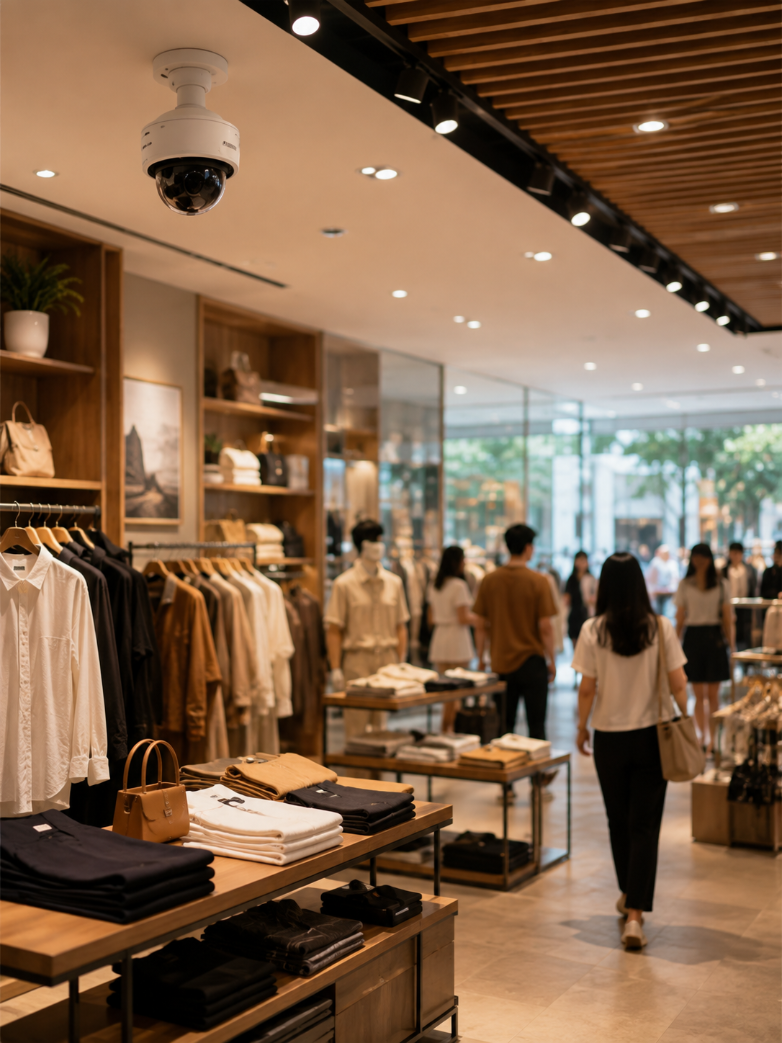
What makes footfall counting in shopping mall atriums difficult?How dense crowds and occlusion affect counting accuracy
The shopping mall atrium is a typical open pedestrian thoroughfare: escalator entrances intersect with main walkways, customers stop and go, and they often walk in groups. Counting 'how many people pass through' in such a space is much harder than counting at store entrances. The difficulty mainly stems from two compounding factors:density and occlusion。
Why do traditional infrared or manual counting methods easily fail in shopping mall atrium scenarios?
Traditional infrared beam counting can only sense 'an object passing through' and cannot distinguish whether it is one person or a group walking side by side, nor can it determine direction. The atrium is an open, multi-directional passage area, where infrared solutions have obvious limitations.
Manual counting can cope with low density and short periods, but during peak hours in the atrium, which often last for several hours, the miss rate rises rapidly after human eyes fatigue, and it is impossible to review and verify, making it difficult to ensure data quality.
How does occlusion in dense crowds lead to missed and false detections?
During event periods, crowds concentrate in the atrium, especially near escalator entrances and promotional booths. When many pedestrians appear in the frame simultaneously, the edges of targets overlap, and the counting system may identify two people as one, or misjudge carried items as another person, resulting in missed and false detections.
Occlusion is almost inevitable in the atrium: customers pass behind pillars, are blocked by companions, are half-hidden by escalator handrails, or are briefly obscured by hanging banners. If the system relies only on single-frame detection, the tracking trajectory will be lost when the target is occluded;when the person reappears, the system may count them as a new target, leading to duplicate counting.
Therefore, the key to counting accuracy in dense crowd scenarios lies in whether the system can continuously and stably track the trajectory of the same target, rather than relying solely on single-frame recognition.
High-Precision Pedestrian Detection and Real-Time Tracking: How 2D AI Cameras Solve the Dense Crowd Challenge
The difficulty of store traffic counting in a shopping mall atrium has never been "someone passing by," but rather "when a group of people passes at the same time, can the device distinguish who is who." Traditional infrared beam sensors can only provide a total count; once two people walk side by side or one closely behind another, the data begins to distort. The HooViz 2D AI Economy Passenger Flow Camera places the answer on the edge: using 2.0 TOPS of AI computing power to perform pedestrian detection and tracking inside the camera, rather than sending the video back to a server for processing.
How does edge AI inference (2.0 TOPS) enable real-time analysis without the cloud?
2.0 TOPS may sound like an abstract number, but its practical meaning is that the camera's built-in chip has the capability to process a 1080P@30fps video stream in real time, identify the outline of a "person" in each frame, and then stitch these recognition results locally into trajectories. The entire process does not rely on external servers, nor does it consume the mall's bandwidth.
This has two direct benefits for the atrium scene. The first islow latency: detection and tracking are completed within the same device; by the time a pedestrian walks from the edge of the frame to the center, the trajectory has already been generated, without waiting for data upload and result return. The second islow privacy pressure: the raw video stream does not need to leave the camera; only statistical results (entry/exit counts, store visit counts, zone heat) are output via RTSP/ONVIF, which is more friendly to compliance requirements in public areas of shopping malls.
How do pedestrian detection and tracking algorithms distinguish individuals and generate continuous trajectories?
The real challenge of dense crowds is 'occlusion'—the person in front blocks the person behind, making it easy for algorithms to mistake two people for one, or to lose track and then re-count. HooViz's solution combinespedestrian detection and trackingtwo algorithms: detection is responsible for finding 'where people are' in each frame, while tracking is responsible for establishing the association of 'this person is still that person' between frames.
Specifically in the atrium scenario, the value of this mechanism is reflected in:
- Distinguishing individuals: The algorithm establishes identity based on the pedestrian's appearance features (contour, color, motion direction). Even if two people briefly overlap, the tracking logic will determine who is who based on motion prediction, rather than simply counting by detection boxes.
- Generating continuous trajectories: Each recognized person generates a movement path from entry to exit.This trajectory is the basis for all subsequent business statistics—entry/exit traffic is determined by "trajectory crossing counting lines," storefront traffic by "trajectory passing through the storefront area," and dwell heat by "the duration a trajectory stays in a certain area."
Can on-device AI inference still work normally when offline?
Yes. This is the fundamental difference between on-device and cloud-based solutions. When HooViz cameras are disconnected from the network, pedestrian detection, tracking, trajectory generation, and entry/exit counting all continue to operate normally, with data stored locally (8GB eMMC, optionally expandable to 16/64/128GB), and synced and exported once the network is restored.
Therefore, even if there are network fluctuations in the mall atrium or temporary disconnection during renovation, statistics will not be interrupted.
However, one point needs to be clarified:When the network is disconnected, data is only stored locally and cannot be viewed remotely in real time.。 If you need real-time monitoring on a large screen or remote reports, a network connection is necessary;if you only need post-event analysis, network disconnection does not affect data integrity.
Who is suitable and who needs further confirmation
| Scenario | Judgment |
| Atrium pass-by store statistics, regional attention analysis | Suitable. Multi-focal lengths (1.1/2.1/2.8mm) adapt to different atrium widths, and ceiling mounting has minimal impact on decoration. |
| Chain headquarters that need real-time remote data viewing. | Suitable, but network connectivity must be ensured; if disconnected, data can only be retrieved afterwards. |
| Need to identify specific customer identities (e.g., members). | Not suitable. This is a 2D camera, only for pedestrian detection and tracking, not facial recognition. |
| Scenarios with higher requirements for counting accuracy and reliability. | Need to be cautious. |
| Any vision solution has error boundaries under extreme crowding (e.g., people pressed against each other during promotions). It is recommended to first provide on-site footage for the team to evaluate. |
Next step to confirm action: If you are concerned about the lens focal length selection corresponding to the atrium width, or want to evaluate counting performance under extreme crowding, send on-site photos or floor plans to the HooViz team to confirm the specific matching solution before making a decision.
How do multiple focal length lenses adapt to different atrium widths?Selection logic from 1.1mm to 2.8mm
The core of choosing a lens for an atrium is not "the wider the better," butwhether the pedestrian head size within the range you want to count is large enough and clear enough. The shorter the focal length, the wider the field of view, but the fewer pixels each pedestrian occupies, and the higher the risk of missed detections and cross-talk in dense crowds.
How do atrium width and installation height affect lens focal length selection?
First, clarify two variables:atrium width(the horizontal range you need to cover) andinstallation height(the vertical distance from the lens to the ground). Together, they determine the actual field of view requirement.
- Width ≤ 4 meters, installation height 2.5–3 meters: A 1.1mm focal length is sufficient to cover the area, with pedestrians occupying an adequate proportion, making it suitable for narrow corridors or small atriums.
- Width 4–8 meters, installation height 3–5 meters: 2.1mm is the sweet spot.The field of view still covers the main passage area, while pedestrian pixel size is sufficient to support stable tracking.
- Width > 8 meters, or installation height exceeding 5 meters: 2.8mm is more reliable.The longer the focal length, the clearer distant pedestrians appear, but the coverage width narrows—you need to accept that only the main passage is counted, not all corners.
An easily overlooked point:Installation height affects model selection more than width.。 For the same 6-meter-wide atrium, the required focal length is completely different when installed at 3 meters versus 6 meters. The higher the installation height, the larger the coverage width at the same focal length, but the smaller the pedestrians appear.
If you can only install at a high position, it is better to choose a telephoto lens and reduce the statistical area rather than a wide-angle lens to cover the full frame—otherwise, the miss rate during dense periods will increase significantly.
What spaces are suitable for different focal lengths (1.1/2.1/2.8mm)?
| Focal length | Suitable scenarios | Characteristics in passenger flow statistics | Not suitable |
| 1.1mm | Narrow passages, small atriums, width ≤4 meters | Covers the most people per frame, but pedestrian pixels are small, and tracking is prone to cross-talk when crowded | Spaces with large width or high installation |
| 2.1mm | Medium atriums, width 4–8 meters | Balances pedestrian clarity and coverage width; it is the default choice for most atriums | An extremely wide atrium requires deployment of multiple units |
| 2.8mm | Wide atrium (>8 meters), high installation position | Pedestrian recognition is most stable with good trajectory continuity, but the coverage of a single unit is significantly narrowed | Scenarios requiring full-width coverage with only one unit installed |
Recommendation: If you have only one installation point and the atrium width exceeds 8 meters, prioritize 2.8mm and accept the narrowed statistical area;If full-width coverage is mandatory, deploying multiple units with 2.1mm is more reliable than a single 1.1mm unit—the latter tends to lose trajectories during peak hours due to small pedestrian size.
Next step to confirm action: Provide the HooViz team with youractual atrium width, installation height, and main statistical area rangeThese three pieces of information allow them to provide specific focal length recommendations and single/multi-unit deployment plans. If you are unsure about the installation height, confirm the ceiling or pole position first, as height changes will directly alter the focal length conclusion.
What practical value does foot traffic data have for mall leasing and operations?
Mall management often faces an awkward situation: they know the atrium is crowded, but they cannot clearly state "how crowded," "from which direction people come," or "which areas they stay in longer." Foot traffic data does more than just "count heads"; it transforms the atrium from a cost center into a quantifiable business asset.
How does foot traffic data assist with brand leasing and rent pricing?
The most core dispute in leasing negotiations is the basis for rent. Traditional practices look at floor level and area, but what brands really care about is 'how many people pass by this location in a day, and how many of them might enter the store.' Foot traffic data provides an objective negotiation anchor:
- Brand fit assessment: For brands that need high exposure and high impulse purchases, the atrium foot traffic is the core metric;If foot traffic is high but dwell time is low, it indicates the location is suitable for pop-up displays rather than formats requiring deep experiential engagement.
- Differentiated rent pricing: On the same floor, foot traffic differences between different stalls can exceed 30%. Pricing by tiers based on actual foot traffic data is more convincing than 'a uniform price with discounts,' and also reduces the expectation gap for brands after they move in.
- Business mix validation: Dining, retail, and experience formats have different sensitivities to foot traffic.Data can tell you which time periods in the atrium have the highest foot traffic peaks, suitable for formats with high rent tolerance, and which periods have clear troughs, requiring traffic-driving formats to fill the gaps.
Besides foot traffic statistics, what other decision support can it provide for operations?
Foot traffic statistics are just the starting point. When devices can output real-time trajectories and dwell time data for areas, the dimensions of operational decision-making will significantly expand:
- Event effectiveness evaluation: For events in the atrium, you can't just look at "how many people came," but also whether foot traffic to surrounding stores has been boosted, how long customers stay in the event area, and which corridors they flow to after the event.This is faster and more direct than post-event surveys or sales data feedback.
- Basis for optimizing traffic flow: If data shows that foot traffic on a certain side of the atrium remains consistently low, it may indicate unclear signage or insufficient appeal of the business mix.After adjustments, comparing data from the two weeks before and after can verify whether the changes were effective.
- Allocation of property resources: Scheduling for cleaning, security, and sales associates can be adjusted based on time-segmented foot traffic data, rather than relying on fixed shifts based on experience.Increase staffing before peak hours and reduce idle time during off-peak periods.
Besides counting people, what other customer behaviors can be analyzed?
The HooViz 2D AI economy passenger flow camera, on top of store visit statistics, can also output two types of behavioral data:Area attention(where customers stop or linger in front of booths or windows, and where their gaze concentrates) andDwell heat map(which locations have the longest customer dwell times). The direct value of these two data points for mall operations is:
- To determine whether the 'eye-catching points' of atrium events align with design intent, rather than just looking at total foot traffic.
- To provide 'location quality' evidence for future leasing—among locations with similar foot traffic, those with higher dwell heat are more valuable for brand display tenants.
Clear data boundaries need to be defined: This equipment outputs foot traffic statistics and trajectory analysis; it does not identify customer identities or collect facial features. Therefore, it cannot answer questions such as "Is this a new or returning customer?" or "What is their spending power?" If lease negotiations require customer profile data, additional data sources need to be supplemented. It is recommended to explain your specific leasing scenario to the HooViz team to confirm how the current solution aligns with your customer analysis needs.
Frequently Asked Questions
Q: Can foot traffic data be directly used as one of the key bases for rent pricing? No. Foot traffic volume is an important reference, but rent should also be determined based on floor level, area, surrounding brand mix, and the overall positioning of the shopping mall.
The role of data is to provide an objective basis for "location differences," reducing disputes caused by purely experience-based judgments.
Q: The atrium is large and crowded. Is a single device enough? It depends on the shape of the atrium and the coverage area. A single device has field-of-view limitations. For a large atrium, multiple devices are usually needed to fully cover the paths past stores.
We recommend providing the atrium floor plan and the desired statistical area boundaries. The HooViz team will then suggest the number of devices and installation locations.
Q: Can the device distinguish between 'passing by' and 'entering a store'? Yes. The device supports separate statistics for entering/exiting traffic and passing traffic. It can determine whether a customer is just passing through or entering a specific store area based on defined zones, which corresponds to the two metrics of 'exposure' and 'entry rate' used in leasing.
Q: How soon can the data be used for operational adjustments? The device processes data in real time on the edge, and the data can be viewed immediately. It is recommended to observe trend changes on a weekly basis, and short-term fluctuations (such as single-day weather effects) should not be directly used as a basis for adjustment.
Learn more
If you are evaluating a plan for counting passersby in the atrium, you are welcome to send the atrium floor plan, installation height, and desired counting area to the team. We will provide specific focal length recommendations and equipment deployment solutions based on actual conditions.
Related products:2D AI Economy Passenger Flow Camera