
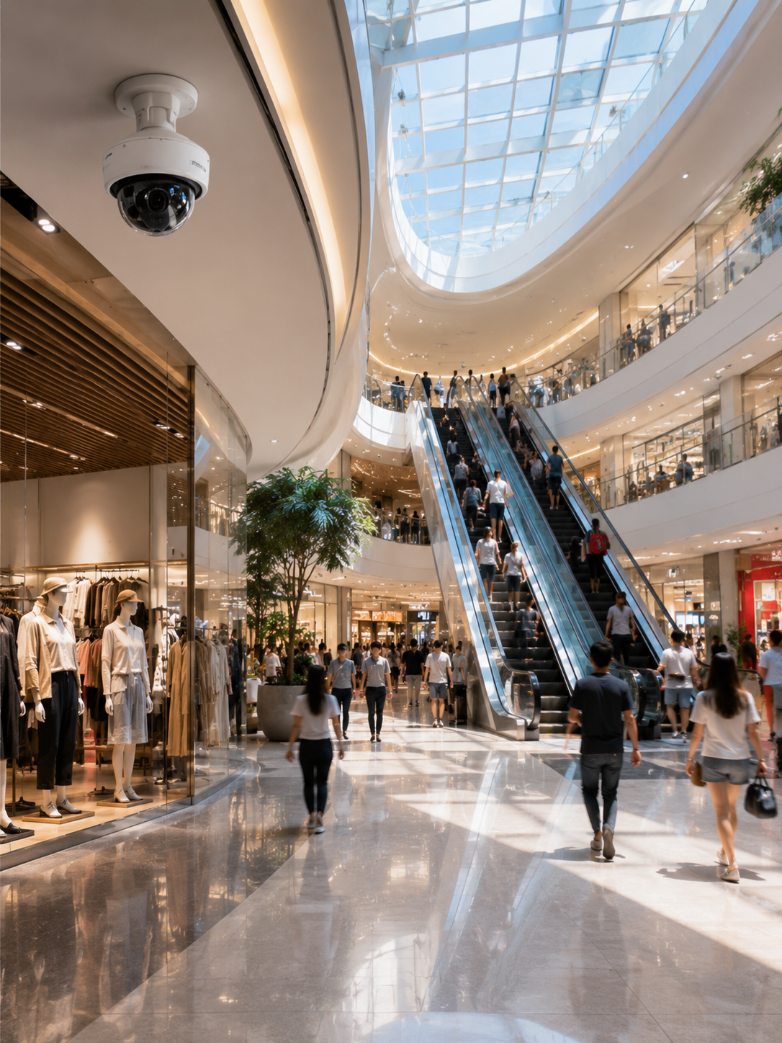
What is the 2D AI Economy Passenger Flow Camera?What passenger flow and heat data can it output?
Simply put, this is not a 'people counting' counter, but an analysis terminal installed on the ceiling that continuously outputs business data. Through its built-in pedestrian detection and tracking algorithms, it identifies the movement trajectory of each person in the frame in real time, and then converts these trajectories into the metrics you truly care about in your operations.
From single-point counting to multi-dimensional analysis: what can one camera do?
In addition to the most basic entry and exit passenger flow statistics, this camera can also output three types of data valuable to retail operations:
- Pass-by traffic: Installed above the store entrance or in the mall corridor, it can count the number of people who 'pass by but do not enter the store'.Combined with foot traffic data, this yields the true entry rate—a key metric for evaluating storefront appeal and window display effectiveness.
- Zone Attention: Designate specific zones within the store or exhibition area, and count how many people pass through and how many stop in each zone.This directly tells you which shelves get the most looks and which display areas are completely ignored.
- Dwell Heatmap: Based on each individual's real-time trajectory, generate a spatial distribution of dwell times.Areas with longer dwell times appear darker, reflecting genuine customer interest rather than your subjective idea of a 'prime location'.
So it's suited to answer not 'how many people came today,' but 'where did customers go after entering, where did they hesitate, and what did they completely overlook?'
How on-device AI inference and high-precision pedestrian detection ensure data quality
This camera is equipped with 2.0 TOPS of on-device AI computing power, and all detection and tracking are completed locally on the device. This means two things:
It works without a network connection. Data is processed inside the camera, and only results are output; raw video does not need to be uploaded. For operators concerned about customer privacy or data compliance, this is a practical security advantage—even if the network is disconnected, the counting function is not interrupted.
The key to data quality lies in 'tracking' rather than 'detection'. Many cheap counters can only recognize 'whether there are people in the frame,' so two people walking side by side, or a person lingering for a moment before leaving, will be counted incorrectly. And this camera does continuous tracking: it remembers each person's movement path, distinguishing between "those who came in and went out" and "new arrivals," thereby reducing duplicate counts and missed counts.
The multi-focal length lenses (1.1/2.1/2.8mm) are designed to adapt to different door widths and installation heights—the wider the door and the higher the installation, the shorter the focal length needed, otherwise people at the edges of the frame will be missed.
It should be clear: on-device inference is more certain that the "processing process" does not rely on the external network, but if you need to remotely view data or interface with third-party platforms, you still need to be connected to the network and interface via ONVIF/RTSP protocols. As for which focal length a specific store needs and what installation height is more likely to ensure accuracy, this depends on your door width and ceiling height—it is recommended to provide these two data points to the HooViz team and let them provide a matching solution.
In retail scenarios, what problems do entrance/exit foot traffic, pass-by store counting, and zone heat mapping solve respectively?
Similarly, installing one camera at the door, in the atrium, or in the exhibition area answers three completely different questions. First clarify which answer you need, then talk about selection.
Store entrance: entrance/exit foot traffic counting and multi-focal length lens selection
The core task of the door camera is to accurately count 'how many people entered and how many left', thereby calculating the true footfall rate—that is, how many passersby are willing to walk in. This number directly determines whether you should focus your efforts on attracting new customers or improving the store's appeal.
Door width is the primary basis for selecting the lens. A 1.1mm focal length offers the widest view, suitable for wide entrances over 3 meters, covering the entire entry area;2.1mm is suitable for standard single doors around 2 meters;2.8mm is used for narrow doors or scenes requiring close-up detail capture. The key to selection is not 'the wider the better', but ensuring that the pedestrian's head and shoulders remain within the recognizable range of the frame throughout the entire process from entry to exit.
If the door is too wide but a telephoto lens is used, pedestrians at the edges may be cut off, leading to missed counts.
Shopping Mall Atrium and Exhibition Areas: Store Visit Statistics, Area Attention, and Dwell Heat Maps
The challenge in atriums and exhibition areas is not just 'counting people' but 'counting them correctly'. In crowded conditions, pedestrians often obscure each other, and ordinary cameras can easily mistake a group of people for a single person. What is needed here are devices with pedestrian detection and tracking algorithms—they can identify individuals and continuously track their trajectories, rather than simply counting heads in the frame.
To determine if a device is up to the task, you can ask two questions: Does it support real-time trajectory output? Does it rely on cloud computing in dense scenarios? Devices with on-device inference offer lower latency and avoid data loss caused by network fluctuations.
Area attention and dwell heat maps address another question: which booth is the most popular? The heat map tells you where crowds gather the longest and where they merely pass through, by tallying the dwell time and density distribution of pedestrians in each area. This has direct value for optimizing booth layout and adjusting displays—place main promoted products in high-heat zones, set up experience areas in locations with long dwell times, rather than arranging them by feel.
How to read the key parameters?Which specifications directly affect installation and usage effectiveness
The most common pitfall in selection is focusing on "how high the resolution is, how fast the frame rate is," while overlooking the three parameters that truly determine deployment success: lens focal length, power supply method, and operating temperature. Below, we explain them one by one in order of impact.
The matching logic between lens focal length and door width/installation height
The focal length directly determines the camera's field of view and recognition distance, and is the key factor in selection.The first parameter to confirm. The HooViz 2D AI economy people counting camera offers three focal lengths: 1.1mm, 2.1mm, and 2.8mm, with the approximate correspondence as follows:
| Focal Length | Suitable Scenarios | Installation Recommendations |
| 1.1mm | Narrow doors and corridors with door widths within 2 meters | Installation height 2.5-3 meters, covering the entrance and exit area |
| 2.1mm | Standard store entrance with door width of 2-4 meters | Installation height of 2.8-3.5 meters, supporting two-way recognition for entry and exit |
| 2.8mm | Door width over 4 meters or need to see a farther area | Installation height above 3 meters, with a more focused field of view and longer recognition distance |
The judgment logic is simple:The wider the door, the shorter the focal length;The higher the installation, the more a short focal length is needed to ensure coverage with confidence.。 But note that the shorter the focal length, the smaller the pixels of a single person in the image, and recognition accuracy will decrease. So it's not that 'the wider the better,' but rather 'just enough to cover the doorway.'
Next step to confirm the action: Measure the actual door width and the available installation height, and provide these two numbers to the HooViz team, who will give specific focal length recommendations. If the store has multiple entrances of different widths, it is recommended to select based on the widest entrance, or use different focal lengths for different entrances.
Power supply method, operating temperature, and system integration capability
These three parameters do not directly affect recognition performance, but they determineWhether it can be installed, whether it is easy to maintain, and whether it can be integrated into the existing system。
- Power supply method: Supports dual power supply via DC12V and PoE.If the store renovation is already completed and rewiring is inconvenient, PoE power supply can handle both power and network with a single network cable, significantly reducing installation costs;If there is already a DC12V power source on site, it can also be used directly.When selecting, just confirm whether there is a PoE switch on site.
- Operating temperature: Wide temperature design of -20°C to 70°C, covering the vast majority of indoor retail scenarios.However, for extreme locations such as semi-open storefronts or near air conditioning outdoor units, it is necessary to confirm whether the actual ambient temperature is within the range, to avoid equipment slowdown due to summer sun exposure or winter cold drafts.
- System Integration: Supports ONVIF/RTSP standard protocols, meaning it can interface with third-party people counting platforms or video management systems.Does it support integration with third-party people counting platforms? The answer is generally, but note: ONVIF/RTSP solves the issue of "being able to pull the video stream," but whether people counting data (entry/exit counts, area heat) can be directly pushed to a third-party platform depends on whether the other platform supports receiving such structured data.If the third-party platform only accepts video streams, then the people counting results still need to be viewed through HooViz's own management interface.
Key Trade-offs: If the store already has a customer flow analysis system and expects the new device's data to be directly integrated, be sure to confirm the third-party platform's interface protocol (whether it only accepts RTSP video streams or supports receiving JSON/API data) before purchasing, and then verify the matching solution with the HooViz team. If you only need independent customer flow statistics and heat analysis without platform integration, the standard configuration will suffice.
Which scenarios are suitable for 2D AI solutions?In which cases is it recommended to confirm requirements before deciding?
The 2D AI customer flow camera is not a one-size-fits-all solution, but it can efficiently solve customer flow statistics problems in specific scenarios. To determine whether it is suitable, focus on three key points: whether your goals are clear, whether the data standards are unified, and whether the expectations for subsequent maintenance are clear.
Suitable scenarios: operators with clear goals and unified data standards
If your requirement is"Knowing how many people enter and exit each day, and which areas have the longest dwell time", and these data are used for daily operational decisions (such as scheduling, display adjustments, and traffic flow optimization), then a 2D AI solution is a highly cost-effective choice. Specifically, the following situations can be directly considered:
- Store entrance foot traffic counting: Need to calculate entry rate and conversion rate, with a fixed door width and clear installation position.
- Heatmap analysis of shopping mall atriums or exhibition areas: Need to understand which areas attract people to stay and the distribution of dwell time, for rent assessment or booth pricing.
- Standardized management of chain stores: Multiple stores need unified customer flow data for horizontal comparison. The on-device inference (2.0 TOPS) of the 2D AI camera can better ensure data consistency without relying on the cloud.
- Renovation-sensitive scenarios: The embedded ceiling design has minimal impact on existing renovations, making it suitable for stores that are already open or places with high aesthetic requirements.
The common characteristics of such scenarios are:You know what data you want, who it is for, and how often you need to view it.The HooViz 2D AI economical customer flow camera supports entry/exit and pass-by traffic, zone attention, and dwell heat maps. Multiple focal lengths (1.1/2.1/2.8mm) can adapt to different door widths, basically covering these needs.
Scenarios to be cautious about: vague requirements or frequent expectation changes
In the following situations, it is recommended to pause and confirm with the team before deciding, otherwise you may find after implementation that "the data is available but not useful":
- You are still unsure about which metrics to track: For example, "install a batch first and see what it can do" - in this case, the data dimensions provided by a 2D AI solution are fixed (entry/exit, store visits, zone heat). If you later find that you need facial recognition, gender/age analysis, or SKU-level shelf recognition, the current solution cannot achieve this through software upgrades; hardware replacement is required.
- Expected outcomes are still changing frequently: For instance, today you want zone heat, next week you want to switch to heatmaps overlaid with trajectory playback, and the month after you want to integrate with ERP for automatic restocking.The data output format of 2D AI solutions is relatively fixed, and frequent requirement changes will lead to increased integration costs.
- Cross-floor or cross-zone linkage analysis is needed: A single 2D AI camera has limited coverage. To perform full-store path linking or cross-zone correlation analysis, multiple devices need to work together, and in this case, you first need to confirm deployment density and network architecture.
- There are extreme requirements for accuracy: In environments with dense crowds, severe occlusion, or drastic light changes, the 2D solution's recognition accuracy will decrease.If safety-related decisions are involved (such as fire evacuation headcount), it is necessary to first confirm whether the on-site conditions are met.
Key information to confirm before implementation
Before deciding whether to adopt the 2D AI solution, it is recommended to confirm the following four points with the HooViz team:
- Installation height and angle: The specific height and tilt angle of ceiling mounting directly affect the detection range and accuracy.Different door widths require different focal lengths (1.1mm is suitable for wide doors, 2.8mm for narrow doors); using the wrong focal length can lead to counting deviations.
- Data integration method: Do you need to integrate with a third-party footfall platform or an existing BI system?The device supports ONVIF/RTSP, but if your platform uses a different protocol, compatibility needs to be confirmed.
- Power supply and network conditions: The device supports dual power supply via DC12V and PoE, but is there already a PoE switch on site?Does the network bandwidth support 1080P dual-stream transmission?
- Data retention period: Local storage defaults to 8GB (optional 16/64/128GB). You need to confirm how long data should be retained and whether regular export is required; otherwise, when storage is full, historical data may be overwritten.
Frequently Asked Questions
Q: Can the 2D AI solution replace 3D or ToF solutions? It cannot completely replace them. The 2D solution is suitable for routine people counting and zone heat analysis, but if precise queue length, shelf out-of-stock detection, or complex behavior recognition is required, the 3D/ToF solution has the advantage.
If the current need is only entry/exit counting and dwell heat, the 2D solution is sufficient.
Q: Can data from multiple devices be aggregated into one platform? Yes, the devices support ONVIF/RTSP standard protocols and can be aggregated through third-party platforms or the integration method provided by HooViz. However, you need to confirm in advance whether your platform supports multi-device data aggregation and the data refresh frequency requirements.
Q: With on-device inference without internet connectivity, is data security guaranteed? The device performs AI inference on the edge (2.0 TOPS), and video streams and detection results are processed locally by default, not forced to be uploaded to the cloud. However, if you need to view data remotely, you still need a network connection, and the encryption method of data in the transmission link needs to be confirmed with the team.
Q: If the door width is judged incorrectly after installation, can the lens be replaced? The lens is configured at the factory, and it is not recommended to replace it on site. If the door width and focal length do not match, you need to contact the HooViz team to confirm whether the device can be replaced or the installation position adjusted.
This is also why it is recommended to confirm the door width and focal length matching plan before installation.
Q: The device operating temperature range is -20°C~70°C. Can it be used outdoors? This temperature range refers to the operating environment temperature of the device itself, but outdoor installation also needs to consider the waterproof and dustproof rating (IP rating). If installed in a semi-open or outdoor environment, additional protective measures need to be confirmed, otherwise rainwater or dust may affect the device's lifespan.
Learn more
If your store or exhibition area is considering a footfall counting solution, you are welcome to submit the door width, installation height, and existing system details to the HooViz team. We will provide focal length recommendations and deployment suggestions based on your actual scenario.
Related products:2D AI Economy Footfall Camera